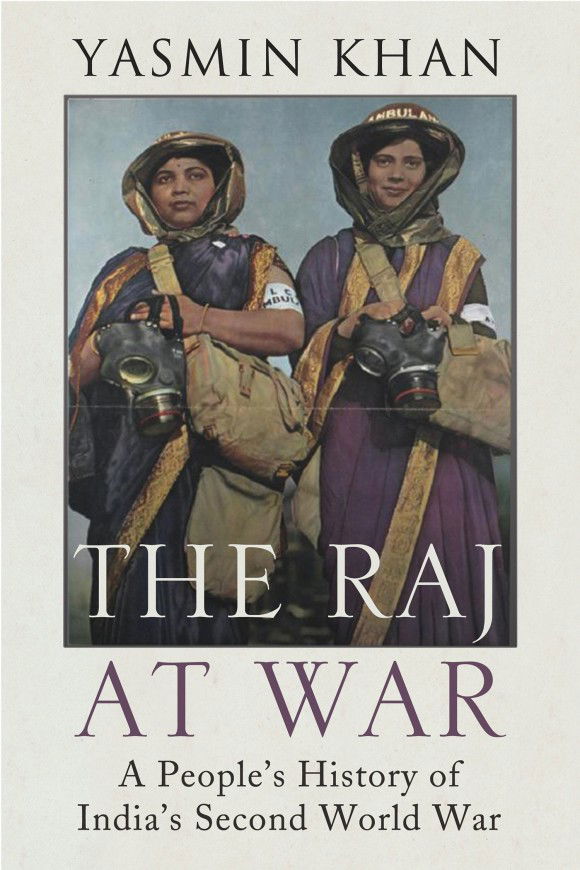
Title: The Raj at War: A People's History of India's Second World War; Author: Yasmin Khan; Publisher: Vintage/Random House India; Pages:433; Price:Rs.699
Moving to London in 1936, Anand Swaroop Mohan, my mother's maternal uncle, joined the Royal Air Force on World War II's outbreak and fought in the Battle of Britain. Her father, Rewati Raman Bakshi, an Edinburgh-qualified doctor, served the war years at command hospitals at Meerut, Jalandhar, Nowshera and other garrison cities. Thousands of families across India and Pakistan will be able to recall similar stories but these are just a part of the war's impact on the subcontinent and its people.
As per conventional, nationalist discourse, what the war years are remembered for are the Congress ministries' resignation, the August offer, the Cripps Mission, Quit India, the Bengal famine, Subhas Chandra Bose and the Indian National Army (and the Red Fort Trial) and for military buff, the Battles of Kohima and Imphal - but all these, though prominent, are only facets of a larger, composite picture.
What has been overlooked so far, contends Yasmin Khan, a professor of history at Oxford University, is the cumulative, comprehensive effect on the Indian "home front" as the country soon faced a total war and its manifold demands and she proceeds to rectify the omission in her second book. (Her debut "The Great Partition: The Making of India and Pakistan" was an incisive account of how partition's politics played among people and the politicians' willful, almost criminal lack of knowledge of what it would entail).
As she brings out, the Second World War saw India becoming a huge troop base with personnel from all over the world (including a substantial component of Americans) while facing the social and economic costs of scores of young men being sent overseas to fight - against Italians in Ethiopia, Germans in north Africa, Greece and Italy, and Japanese in Burma and on the Indian borderlands itself. On the other hand, women, most middle class but of other strata too, enjoyed new freedoms as they engaged in war work, as nurses, in industries and auxiliaries, with gusto. And then the cultural impact (remember the Americans).
There was the major expansion in the state's powers and functions, a disruption to the local economies, food shortages and inflation - paradoxically, the same time as industrialisation, infrastructure development, and even consumer comforts - refrigerators and tinned food - received a huge boost.
But most significant was in the political realm - the radicalisation of a large number of the populace, especially among the armed forces (the bulwark of the empire), the growing communal divide, the focus of a wider British audience, which swung from antipathy at moves to scuttle the war effort to sympathy for Indians' aspirations for self-rule and, most importantly, how the experiences shaped the course of decolonisation, and of Independence and Partition. It must be remembered that August 1947 was just two years after British voters (a large portion of them servicemen) seeking a more equitable order, ejected the Conservative government of Winston Churchill, which had won the war.
Considerable responsibility for the acceleration for empire's end can be laid at the door of the heavy-handed Viceroy, the Marquess of Linlithgow, who not only unilaterally took India into the war but also compounded his blunder by never seeking to reach out to the people at large to win their support. (Why his contribution to the freedom struggle is not lauded remains a mystery!)
Aruna Asaf Ali, (then) Lt.P.S. Bhagat VC, and G.D.Birla are among the familiar people we encounter but Khan in her book also brings out stories of many whose contribution was no less crucial but would have been fated to remain unsung - the Lascars, who were the backbone of the merchant marine, and the armed forces' vital support staff - tailors, cobblers, washermen, nurses, farmers, labourers, even prostitutes.
As a chronicle of these turbulent times and their effect on present South Asia, this work can scarcely be bettered.