New Delhi/Helsinki, March 17
Finnish President Alexander Stubb has suggested that India could play an important diplomatic role in easing tensions between the United States and Iran, urging an immediate ceasefire as the conflict in West Asia continues to intensify.
In an interview with Bloomberg, Stubb said global efforts should focus on halting hostilities and opening channels for dialogue, while noting that India could potentially contribute to diplomatic efforts aimed at reducing tensions.
"We need a ceasefire... I'm wondering if India can actually get involved. We saw Foreign Minister Jaishankar call for a ceasefire to calm things down," he said.
The Finnish President's comments came at a time when New Delhi has been actively engaging with Tehran amid the rising confrontation in the region.
Recently, India's External Affairs Minister (EAM) S. Jaishankar held another round of telephonic talks with his Iranian counterpart, Abbas Araghchi, to discuss the rapidly evolving situation.
During the conversation, Araghchi briefed India on the latest developments and described the ongoing conflict as a consequence of what he called "aggressions" by the United States and Israel. He also conveyed Iran's intention to exercise what he described as its right to self-defence while cautioning that the situation could lead to wider regional and global repercussions.
India has been closely monitoring the developments, particularly due to concerns over regional stability, energy supplies and the safety of Indian nationals in the region.
As part of India's diplomatic outreach, Prime Minister Narendra Modi also spoke with Iranian President Masoud Pezeshkian amid the escalating hostilities.
Following the discussion, PM Modi said he conveyed India's deep concern over the intensifying conflict and the growing number of civilian casualties. He also emphasised that ensuring the safety and security of Indian citizens in the region, along with maintaining uninterrupted transit of goods and energy supplies, remains a top priority for New Delhi.
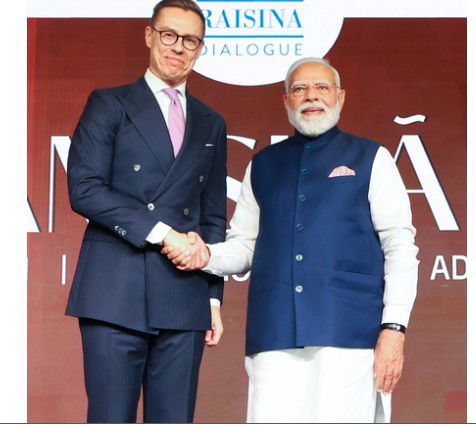
Stubb's remarks also came in the backdrop of his recent state visit to India from March 4 to 7, 2026, during which he attended the Raisina Dialogue as the Chief Guest.
During the visit, the Finnish President praised India's global standing and its growing role in international affairs, while highlighting the country's economic growth and foreign policy approach.
Speaking at a joint press statement alongside Prime Minister Modi, Stubb described India as "one of the world's largest and most influential countries and the world's largest democracy", and referred to it as a crucial strategic partner for Europe.
He noted that India's significance in areas such as foreign and security policy, as well as trade and economic cooperation, was becoming increasingly important for European nations.
Stubb also highlighted India's economic trajectory, calling it one of the fastest-growing major economies in the world.
He praised New Delhi's foreign policy framework for being shaped by what he described as a pragmatic and realistic worldview.
According to him, India's diplomatic approach balances strategic caution with the need to safeguard its autonomy while continuing to support multilateral cooperation on global issues.
Reflecting on New Delhi's role in international diplomacy, Stubb remarked, "I believe personally that we should all become a little bit more Indian."
At the Raisina Dialogue, the Finnish President further emphasised India's expanding role on the global stage, including its contributions to peacekeeping operations and its constructive engagement within the United Nations.
He also highlighted India's ability to balance national interests with broader global values and principles while engaging with countries across different regions.
Stubb suggested that New Delhi is emerging as a key actor in shaping the evolving global order, particularly as countries of the Global South gain greater influence in international decision-making.