Washington, Feb 17
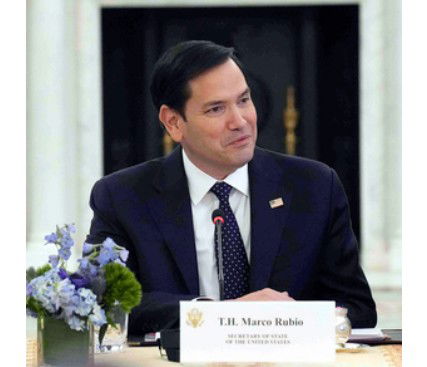
Declaring that Washington would not demand ideological loyalty tests from its partners, Secretary of State Marco Rubio said that under President Trump, the United States expects “every nation on Earth” to pursue its own national interest — and is “not asking any country in the world to isolate themselves from anybody,” including China.
In remarks that could resonate well beyond Hungary — including in New Delhi — Rubio framed the Trump administration’s foreign policy as pragmatic rather than prescriptive, even as the United States competes strategically with Beijing.
“Under President Trump, it is our expectation that every nation on Earth is going to act in their national interest,” Rubio said at a joint press appearance with Hungarian Prime Minister Viktor Orban in Budapest. “We’re not asking any country in the world to isolate themselves from anybody,” he told reporters.
To underscore the point, he cited America’s own engagement with Beijing. “It would be crazy — okay, it’s insane for the United States and China not to have relations and interact with one another,” he said, noting that President Trump is scheduled to travel to China in April.
The comments came during a visit to Budapest where the United States and Hungary signed an agreement to facilitate cooperation on Hungary’s civilian nuclear program. But the broader significance of the visit lay in what it signaled about Washington’s evolving approach to allies and partners who maintain economic or political ties with China.
Hungary, a NATO and European Union member, has in recent years deepened Chinese investment and retained carve-outs to purchase Russian energy. Asked why Washington was not conditioning deeper cooperation on Budapest reducing its engagement with Beijing, Mr. Rubio rejected the premise that alignment required isolation.
“We understand that every country in the world has to deal with the reality of their geography, of their economy, of their history, and of the challenges of their future,” he said.
Still, the Secretary paired his openness to engagement with a clear economic caution — one that reflects a broader U.S. push to diversify supply chains.
“It is not good for the world — it’s not good for anybody — to rely on one country or one economy for 90 percent of anything, especially things like critical supply chains,” he said, calling overdependence a vulnerability rather than a geopolitical virtue.
The Budapest event itself reinforced the centrality of personal diplomacy in the current U.S. approach. Rubio repeatedly pointed to the “very, very close personal relationship” between President Trump and Orban as a driving force behind bilateral decisions, including energy-related waivers.
“The prime minister and the President have a very, very close personal relationship and working relationship,” Rubio said, adding that it had been “incredibly beneficial to the relationship between our two countries.”
Orban welcomed the Secretary warmly, describing the current moment as a “golden age” in U.S.-Hungarian ties and thanking President Trump directly.
Beyond China, the two leaders addressed the war in Ukraine. Rubio said Washington’s objective was straightforward: “The United States interest is to see the war end, and we want to do what we can to make it end.” He argued that the United States was uniquely positioned to bring both sides to the table and said recent technical-level talks between military officials had resumed.
“We’re not seeking to impose a deal on anybody,” he said. “We just want to help them.”
On Iran, Rubio acknowledged the difficulty of negotiations, describing any potential agreement as challenging but reiterating that the President “always prefers peaceful outcomes.”
The nuclear cooperation agreement signed Monday adds another layer to a relationship both men described as unusually close. Rubio said it was one of what he hoped would be “many” agreements in the years ahead.
But it was his comments on national interest and China that are likely to echo far beyond Budapest. By publicly stating that Washington does not expect countries to isolate themselves from Beijing, even as it warns against economic overdependence, the administration is sketching a doctrine that blends competition with realism — and signals to partners that strategic alignment with the United States does not require cutting off the rest of the world.