New Delhi, Feb 13
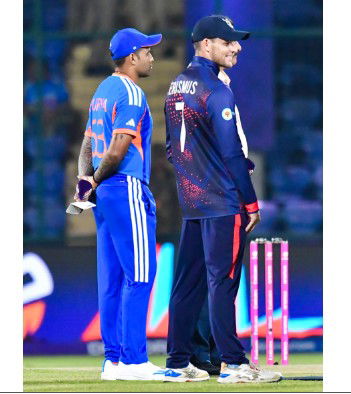
Namibia head coach Craig Williams praised Gerhard Erasmus for picking career-best figures of 4-20 against India despite his team suffering a 93-run defeat in their Group A clash at the Arun Jaitley Stadium on Thursday evening, adding that the skipper showed the world yet again about his skills with the ball.
Mixing high-arm and round-arm releases, including releasing the ball from behind the crease, Erasmus exploited just enough grip in the pitch to trigger double wobbles of the Indian batting line-up. He introduced himself in the eighth over and struck first ball, cramping Ishan Kishan on the pull and having him caught at deep midwicket.
Alongside left-arm spinner Bernard Scholtz, he throttled India’s scoring, as the pair conceded just 30 runs in six overs while removing Suryakumar Yadav and Tilak Varma in the attempt to break free. Erasmus returning in the 19th over looked a gamble against two set hitters. But substitute Dylan Leicher’s juggling catch at deep square leg to remove Hardik Pandya turned the tide. Axar Patel then misread a slow, low-arm delivery, leaving Erasmus with four wickets against his name.
"Look, he trains incredibly hard at all these variations, and he plays cricket around the world in some leagues. He bowls all the difficult overs, and some really tough overs. He's continuously working on his game and trying to see how he can be more effective against batters. Again, against a world-class cricket team, he showed the world again what he's got and his execution was just really good."
"I think his first three overs went for 16 or something like that and then to bowl that 19th over as all under pressure - first ball going for six and then pulling it back, I think it was just really fantastic. So I'm really happy for him - he trains hard and he works hard on these variations in his game," said Williams, while replying to a query from IANS in the post-match press conference.
He further defended Erasmus's unconventional bowling technique, saying it was part of his standard approach. "He bowls like that as part of his armoury. It's part of his toolbox to bowl a ball from behind the stumps. He's done it for a number of years. So there wasn't a specific tactic against India to do that. It's basically the way that he bowls and over to get. Again, he got quite a bit of success out of it."
The Namibian coach was pleased with his team's bowling performance, particularly in restricting India to 209/9, especially with last five wickets falling in final 11 balls of the innings. "There's a lot we can take out of this game. We really bowled well towards that back end. It was a tough power play and the players of India's calibre when they take on the first six, it wasn't looking too good for us.
“But the guys showed a lot of courage and they stuck to our plans. To go last three overs, less than 20 runs, and taking those four or five wickets is really, we're really going to bank that moving forward in the tournament."
Williams also noted his team maintained composed despite the pressure of facing India in front of a crowd of 33,400. "The crowd doesn't affect us that much anymore - it's our fourth World Cup. I was actually quite impressed with how calm we were and collected. You can actually see there was a lot of calmness. So quite happy with the way we handled that.
“The key points in the game - the way we bowled is just - we've been bowling really well as a unit. To keep India to 210 on that wicket I thought a really good wicket and if you look at the average scores we kept them actually below what an average score is over here for a team batting first in T20Is. So look really, really happy with the courage the boys showed."
Namibia reached 85/2 in nine overs of the uphill chase but lost momentum in the middle period, thanks to Varun Chakaravarthy picking three wickets in his first ten balls. "After eight overs or nine overs being 85 for two, we really set ourselves up with a chance and that's all that we asked the batting unit is let's see where we get at and if we have a chance we're going to try take it and we took a decision in terms of tactics to try have a very good middle period and that's where we lost a few wickets."
"I mean we couldn't take it to the back end of the game with Bumrah and those guys to try get 14 -15 runs an over against him would never happen. So I just think that our end score doesn't really show a true reflection of the great effort that our guys gave."
Williams further explained the decision to bowl first was influenced by dew present at the ground, though Namibia didn’t get any evening practice slot. "We took all factors into play and the dew was a big one. It was quite wet out there now and obviously we're not used to playing with a ball that's wet, it would have been quite tough against that batting unit.
“So, look, we thought to give ourselves the best chance, we could try to come hard with the ball and then obviously give it a shot at chasing whatever India puts on the cards. Our batting unit was really courageous in the middle period to try to take on that bowling attack. Unfortunately, didn't work out for us.
“On another day, Gerhard, and the guys, J.J. (Smit) and they might have come off a bit longer, which would have put us in a better position. But I'm really, really happy with the boys. At certain areas of this game, we actually put a world's number one team under pressure."
India wicketkeeper-batter Ishan Kishan acknowledged Namibia's strong bowling performance. "They batted pretty well. In both wickets, I feel it was a bit different from what we expected to happen. Looking at the death overs, when we were not able to regularly hit big sixes, we need to also give credit to Namibia bowlers because they were bang on with their yorkers and slower ones."
"It was a good learning - maybe if some other team is doing the same thing - maybe we can use the crease more or we can do something different which can irritate the bowler. So it was a good learning in this game and especially it was not about our batters not able to hit sixes, but it was more of them bowling very well in the death overs."
-