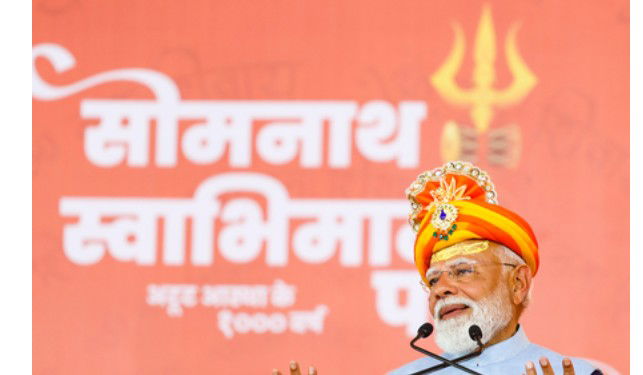
Somnath (Gujarat), Jan 11
Prime Minister Narendra Modi on Sunday recalled the repeated attacks by foreign invaders on the Somnath Temple, and said that the story of the sacred shrine should not be confined to episodes of destruction alone, but should also be remembered for the courage, sacrifice and determination that led to its reconstruction every time it was attacked.
He said that Somnath Temple's journey not only marks 1,000 years of resilience and self-respect but also commemorates 75 years since its modern reconstruction in 1951.
Addressing a large public gathering at Sadbhavna Maidan after offering prayers at the revered shrine, PM Modi delivered a passionate speech and said, "This festival is not meant only to remember the destruction that took place a thousand years ago. It is a celebration of a 1,000-year journey. It is also a festival of India's existence and pride."
Drawing parallels between the nation's history and the temple's legacy, he said that India and Somnath have faced similar challenges.
"The way many efforts were made to destroy Somnath, similarly, foreign invaders made continuous efforts to destroy our country. But neither Somnath nor India was destroyed. This is because India and the core of India's faith are deeply intertwined," he added.
Recalling historical events, PM Modi said, "A thousand years ago, in 1026, Mahmud of Ghazni first attacked the Somnath Temple, thinking he had destroyed it. But within a few years, it was rebuilt. In the 12th century, King Kumarapala made the temple grand. In the 13th century, Alauddin Khilji attacked again, but Rana Kumbha of Jalore resisted fiercely. Later, in the early 14th century, the kings of Junagadh restored Somnath."
"In the late 15th century, Sultan Ahmed Shah attempted to desecrate the temple, followed by his grandson Sultan Mahmud Begda, who tried to convert it into a mosque. However, due to the efforts of Lord Mahadev's devotees, the temple was rebuilt. In the 17th and 18th centuries, Aurangzeb also tried to harm the temple and again attempted to make Somnath a mosque, but Ahilyabai Holkar reconstructed the temple once more," he further said.
The Prime Minister stressed that Somnath's narrative should be associated not with loss, but with the strength and resolve of those who rebuilt it repeatedly.
"This shows that the history of Somnath is not of destruction and defeat, but of victory and reconstruction, of the valour, sacrifice and selflessness of our ancestors," he said.
"Religious and other attacks came again and again, but in every era, Somnath was rebuilt. Centuries of struggle, long resistance, and immense patience and creativity kept it alive. Such strength, faith and resilience in our culture are rare examples in world history," he added.
Explaining the deeper meaning of the name Somnath, PM Modi said, "From Mahmud of Ghazni to later invaders, all who attacked Somnath believed their swords could defeat the Sanatani Somnath. Their intention was rooted in religious fanaticism, but they did not realise that Somnath itself means 'Som' -- immortality."
"Within it resides the eternal power of Lord Shiva, a force of creation and protection, the very source of divine energy," he said, adding that another name of Lord Mahadev is 'Mrityunjaya', meaning one who has conquered death.
He said Lord Shiva is present everywhere, and that is why "we see Shankar in every single particle".
"How much can anyone destroy it? We are people who see Shiva in every living being. Then how could anyone have shaken our devotion?" PM Modi asked.
He said time has proved that those who attacked Somnath with the intention of destruction have faded into history.
"Religious fanatics who came to destroy Somnath are now confined to the pages of history, while the Somnath Temple still stands tall on the shores of the vast ocean, touching the skies and upholding the banner of dharma," he added.
Referring to the Somnath Swabhiman Parv, the Prime Minister said it is not merely a remembrance of the past but a way to keep a timeless journey alive for the future.
He said India must use this occasion to further strengthen its existence and identity, just as other nations proudly showcase their centuries-old heritage before the world.