Washington, Jan 7
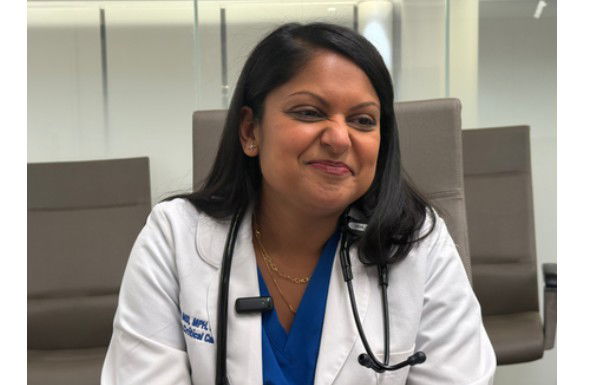
Indian American Dr Tina Shah’s entry into electoral politics grew out of years spent in intensive care units, where she treated patients whose conditions deteriorated after medicines were denied or care was delayed.
Shah is now among several Democrats and the only Indian American seeking the party’s nomination in New Jersey’s 7th Congressional District, arguing that the systemic failures she encountered in hospitals are the direct result of decisions made in Washington.
“I never thought I would run for office,” Shah said. “But every time I practice, I see somebody coming in because they couldn’t afford their medicines or the insurance company denied that MRI that they needed,” she told IANS in an exclusive interview.
A triple board-certified physician in internal medicine, pulmonary medicine, and critical care, Shah says her decision to enter the race followed years of witnessing systemic failures at the bedside. “We’re in the US, and we don’t have a good healthcare system, and we have to fix it,” she said.
Shah argues that recent policy decisions have worsened conditions for patients, particularly those with limited means. She pointed to cuts in Medicaid coverage and the loss of insurance subsidies for people purchasing plans through the Affordable Care Act exchanges.
“People that are the most vulnerable, they don’t have health insurance starting this year,” she said, adding that Congress has failed to rein in high drug prices or curb insurance denials.
One case, she said, still weighs heavily on her. A patient with asthma had been stable for nearly a decade until a change in insurance required prior authorisation for inhalers. The request was denied, the patient ran out of medication and was later admitted to the ICU on a ventilator. “This shouldn’t happen,” Shah said.
That experience helped push her into advocacy work in New Jersey, where she joined doctors, nurses and patients in a grassroots campaign to stop state-regulated insurance companies from denying essential care.
Working with legislators, Shah said the effort generated enough public pressure to force action. “Now if you have insurance in New Jersey that the state regulates, you will actually not have this situation where essential care gets denied,” she said, adding that similar protections are needed nationwide.
Beyond clinical practice, Shah has served in senior policy roles across three White House administrations. As a senior advisor to the US Surgeon General, she helped lead the federal government’s first strategy to address clinician burnout. At the Department of Veterans Affairs, she became the agency’s first National Director of Clinician Wellbeing, focusing on improving electronic medical records and expanding primary care access for veterans.
She later moved into the private sector, becoming the first chief clinical officer of a healthcare-focused artificial intelligence company, where she worked on reducing administrative burdens so clinicians could spend more time with patients.
Shah has been sharply critical of President Donald Trump’s healthcare approach. “He has no concrete policy except to dismantle the things that are working,” she said, citing the removal of scientific experts from federal agencies and cuts to medical research funding. “How are we supposed to stay the superpower when we don’t invest in breakthrough science and research?” she asked.
While acknowledging Trump’s efforts to negotiate lower drug prices, Shah said the impact has been limited. “A cost of a medicine that’s still more than $1,000 a month is still too much,” she said, adding that tariff uncertainty has created confusion for patients trying to decide when to purchase medications.
Shah’s candidacy is also shaped by her identity as a second-generation Indian American. She traced her family’s journey to parents who came to North America seeking opportunity and invested heavily in their children’s education. “One of the best parts about being Indian is that our community is so strong and we lift each other up,” she said.
Despite the size and economic influence of the Indian American community in New Jersey, Shah said political representation has lagged. She pointed to issues such as the H-1B visa debate and a rise in hate crimes as reasons more voices are needed in Congress. “We need to make sure we have loud voices in Congress to represent the challenges we have,” she said.
On hate crimes and immigration enforcement, Shah said, “There’s no place for hate like that,” adding that due process and equal treatment under the law must apply to everyone.
She described New Jersey’s 7th District as central to Democratic efforts to regain control of the House, noting that it is one of a handful of seats needed to flip the chamber. Shah has been outspoken in her criticism of the incumbent Republican, Tom Kean Jr., whom she described as a career politician disconnected from constituents. “I’m calling him out and I’m going to beat him,” she said.
Her campaign has reported early fundraising strength. In a release on Tuesday, her team said Shah crossed the $1 million mark, raising $1,017,000, and framed the campaign as focused on lowering costs for families, protecting reproductive rights and expanding access to healthcare.
Balancing medicine and campaigning has been demanding, Shah acknowledged, but she says continuing to practice keeps her grounded. “Every day on practicing, I talk to people in my district and I understand their challenges,” she said. “As a doctor, I’m ready to help them.”
If elected, Shah would become the first Indian American to represent New Jersey in Congress. Indian Americans currently hold only a small number of seats in the House, a figure that does not reflect the community’s population or influence, she argues.
New Jersey’s 7th Congressional District, which includes several suburban communities with a significant Indian American presence, is expected to be one of the most closely watched House races in the country, with national implications for control of Congress.