New Delhi, Dec 31
An ancient desert city, mysterious ruins, the constant cosmic conflict between good and evil, a powerful but lost talisman that could affect its outcome, a young heroine yet to come to terms with her hidden abilities but thrust into the maelstrom, and the like - all these portend to be sparkling ingredients for an engrossing urban fantasy.
And fledgling author Sunali Singh Ranaa doesn't disappoint with her first work, which promises to be the first of a riveting sword-and-sorcery series - with a unique Indian infusion but also a twist, as we shall see.
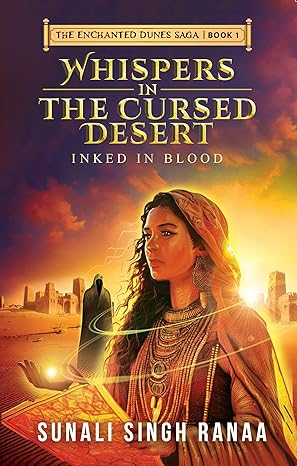
In 'Whispers in the Cursed Desert: Inked in Blood', the first of 'The Enchanted Dunes Saga' (Readomania/pp244/Rs 399), Rana, who happens to be an energy expert leading sustainable energy practices at industry chamber CII, spins the tale of Layla, a resident of the ancient desert city of Zephyria and beginning a graduate course in archaeology at a university said to be in Egypt.
While both her home city and her institution - and the people - are more than what they appear to be, she is yet to achieve closure over the disappearance of her father some years back, and the strange things that suddenly begin to happen to her. And the simplest - ostensibly - of these is a budding romance, but this also is fraught with complications for our festy heroine.
Revealing any more of the storyline may be a spoiler for interested readers, beginning right from the ominous prelude, the cliff-hanger ending, and the enigmatic epilogue, so it will be better to focus on some overarching trends about Ranaa's saga.
Urban fantasy has always been a fertile realm of literature, and well before the advent of the Harry Potter or the Percy Jackson (and its numerous spinoffs) series, but Ranaa, whose journey combines "her professional expertise with a deeply intuitive approach to living", creates her own special brand.
Comparisons with the boy wizard's tales are bound to be drawn, given the underlying theme of magic, parent-linked trauma, an institution where magic is not looked at askance, and even a rather singular teacher, whose name, approach - chocolate for the disturbed - and favoured abode brings to mind a popular Defence Against Dark Arts teacher of Hogwarts!
However, Ranaa's tale is more multifaceted.
While there are times when her work seems to be verging towards becoming a "fantasy sink", with what seems to be a surfeit of magical plot elements, it must be appreciated that the first instalment of a series is not where judgment can be made, as there is a long road ahead for the resolution of the multifarious constituents.
But what really makes Ranaa's work stand out is the universality she manages to bring about with this trend.
Urban fantasy, or sword or sorcery, is not alien to the Indian literary tradition, with too many examples to list here. But one issue that is seen often in contemporary works, say Anuja Chandramouli's gritty yet compelling retellings, is that inspiration from the Indic mythic tradition imposes its own limitations on character and plot. Ranaa plays safer here, with her policy, like Samit Basu with his 'GameWorld Trilogy' - being to create an entirely new world, though including traits and tropes from the prevailing mythos.
And hence Ranaa's Zephyria and Antara seem mostly familiar, though there is an element of subtle mystery that saves them from being compared to real-world locations, even the mystical Arabia of the Thousand and One Nights, and the characters draw on a larger pantheon than the subcontinent or even Arabia, for that matter.
The result is not difficult to discern -- the ambience is well created, the characters are well drawn, the situations seem well crafted, and though there may be a false note or two in the narrative, the effect is not too jarring.
In all, Ranaa offers a gripping tale that will not only beguile its readers but leave them waiting for the later instalments.